
Import from Git V2: Maintain Sync Link Imports
1. What Sync Link means
Sync Link creates a persistent relationship between:
- a Testany import history
- the selected Git files
- the resulting Test Cases
In this mode, scripts are fetched from Git at execution time.
This means the import history does not rely on a Testany-managed Mirror for execution.
2. Read the detail page
Open Import History and then open a record with the SYNC LINK badge.
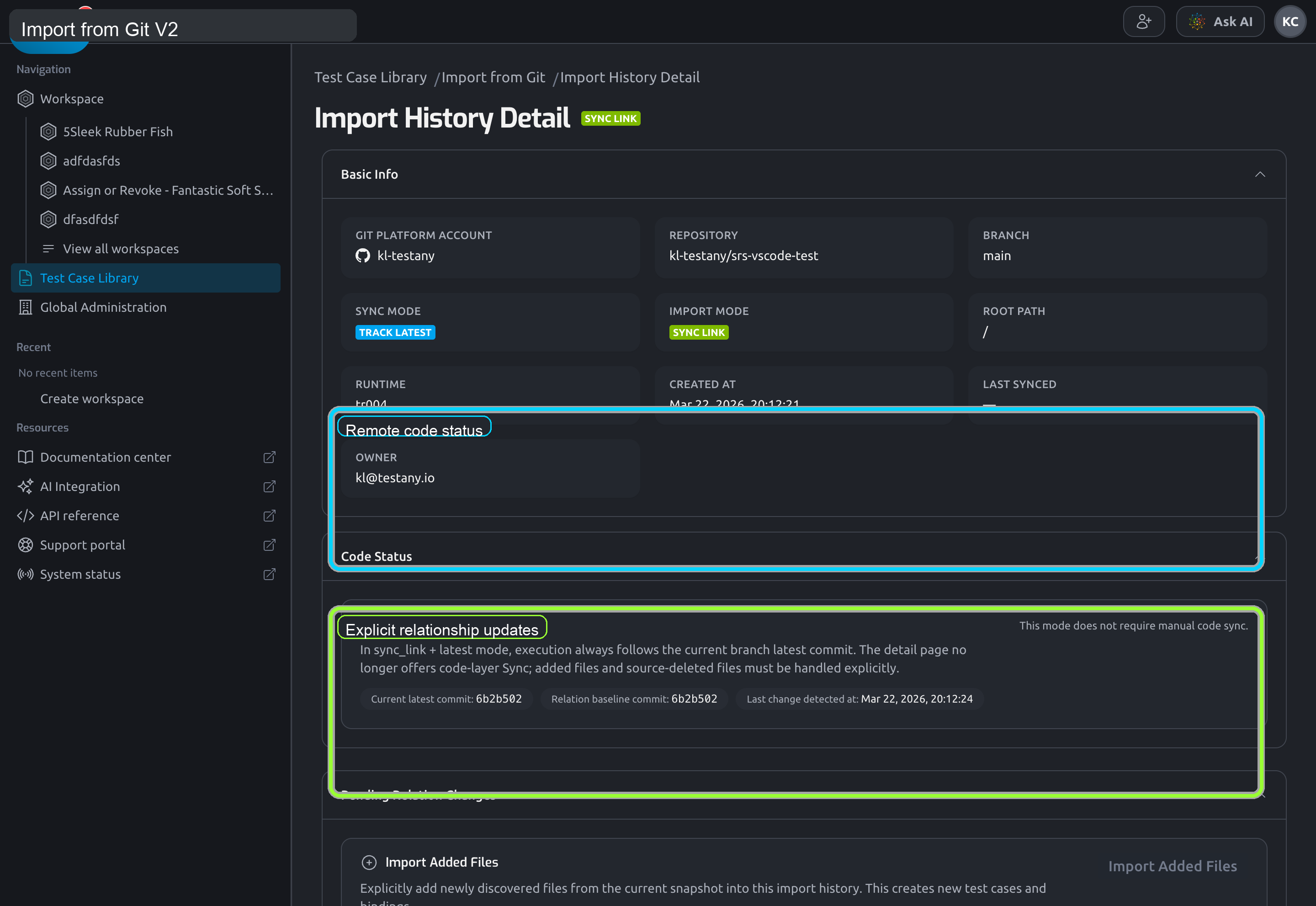
The page usually contains:
Basic InfoRemote Code StatusPending Relation ChangesAssociated FilesGitHub Webhook SyncSync HistoryDanger Zone
3. Sync Link in Track Latest mode
In Sync Link + Track Latest:
- execution always follows the current branch latest commit
- the detail page does not provide code-layer
Sync - new files and deleted source files must still be handled manually
The Remote Code Status area shows:
Current latest commitRelation baseline commitLast change detected at
This is a key V2 behavior. Track Latest does not mean “automatically create new Test Cases for new files” or “automatically remove deleted files.”
4. Sync Link in Pinned Commit mode
In Sync Link + Pinned Commit, the import history is locked to one commit.
The detail page lets you use:
Switch CommitSwitch to Track Latest
This mode does not support webhook sync or code-layer sync. To move forward, you must explicitly switch commit or leave pinned mode.
5. Handle relationship changes explicitly
In Pending Relation Changes, Sync Link separates relationship maintenance from code tracking.
5.1 Import Added Files
Use Import Added Files when the latest snapshot discovers new supported files that are under the import root but not yet part of this import history.
This action creates:
- new Test Cases
- new bindings in the same import history
5.2 Mark Source Deleted
Use Mark Source Deleted when a previously tracked file no longer exists in the Git source.
This action:
- marks the binding as
source_deleted - does not automatically delete the Test Case
If the file is still referenced by pipelines, review the impact before confirming.
6. Configure GitHub Webhook Sync
GitHub Webhook Sync is available when the import history is in Track Latest.
Its job in Sync Link mode is to:
- receive GitHub push events
- trigger sync checks when needed
It does not directly create new Test Cases or delete existing ones.
6.1 How to set it up
- In Testany, click
Configure Webhook. - Copy the generated
Webhook URL. - Copy the generated
Secret. - In GitHub, open the repository webhook settings.
- Configure a
pushwebhook with that URL and secret. - Return to Testany and verify deliveries.
6.2 Tracking scope
The webhook panel also allows a tracking scope with include/exclude rules. Use it when you only want part of the repository to trigger sync checks.
6.3 Pinned mode limitation
If the import history is pinned to a commit, webhook sync is unavailable until you switch back to Track Latest.
7. Review Sync History
Use Sync History to review the past sync checks and outcomes for this record.
This helps answer questions like:
- when Testany last detected upstream code changes
- whether a sync check failed
- whether the current relationship snapshot is stale
8. Delete a Sync Link import history
In Danger Zone, Delete Import History removes the import history and deletes all associated Test Cases.
This action is irreversible. Review pipeline references and business ownership before deleting the record.
Still have questions?
Our team is here to help. Get in touch and we'll get back to you as soon as possible.